


June 2026 · ~ 9 min read
Dr. Paid or: How I learned to stop worrying about the Last-click and love the measurement
Most e-commerce directors and managers currently live in a state of permanent analytical paranoia. On one hand, we see shrinking margins eating into our P&L; on the other, ad network reports look like they were written by die-hard optimists. Google and Meta enthusiastically grade their own homework, handing themselves straight A's. Why, then, is it getting harder to trust dashboards when it comes to the entire business pie, rather than just a narrow slice of it?
There is no silver bullet here. There is no single, perfect system that will show you the absolute truth about which channel delivers best. Efficiency doesn't come from believing in dashboards; it comes from testing. True business maturity begins when, instead of chasing after a mythical single "source of truth", you accept the complexity of data and perspectives and learn to manage them.
The anatomy of an algorithmic hallucination
To embrace modern measurement, we first need to understand why current dashboards resemble a theater of illusions. After Apple cut off signals (iOS 14.5 and ATT), ad ecosystems permanently lost 40-60% of direct conversion data. The global opt-in rate for ATT hovers around a dismal 15-25%.
In response to this crisis, the platforms didn't back down – they rolled out probabilistic modeling. The result? Artificial ROAS inflation of 20-40% in ad panels. We’ve reached a point where the total revenue claimed by algorithms can be up to 2x higher than the actual revenue recorded in your store backend. On top of that, implementation errors can easily creep in, further widening these discrepancies.
Clinging to platform reports and Google Analytics as your sole gauge of performance is a direct path to capital self-destruction.
The Last-Click Syndrome: How We Pay for Free Customers
Our attachment to the Last-Click model is psychological: it provides an illusion of control. In practice, however, this model acts like a guided radar that frequently targets channels already capturing existing demand – primarily brand search and tight retargeting.
Hard market data shows, however, that 60% to 80% of conversions attributed to brand search campaigns would have happened naturally through organic traffic anyway.
For an e-commerce manager, the takeaway is simple: you are paying a commission for customers who were already standing at your store's doorstep with their credit cards out. Does this mean you should switch off these campaigns entirely? There is no one-size-fits-all answer. Cutting off brand keywords in a highly competitive niche might end up handing traffic over to rivals, while in other cases, it will purely free up margin. Striking this balance requires regular analysis and incrementality testing, which we will get into shortly.
Fair enough, but does that mean we should write off Last-Click entirely? Not quite. Traditional analytics models still hold ground today. What’s more, in justified cases, they can continue to be an effective tool backing up measurement during specific periods – for instance, when the sales cycle in a competitive industry wraps up in less than 7 days, or when you generate over 1000 conversions a month from highly stable customers. If your business doesn't fit into this framework, Last-Click might turn out to be a false prophet.
Strategic Mapping of the Front: MMM Across Scenarios
We already know that tracking every single user is now a fiction. This is where Marketing Mix Modeling (MMM) steps in – a strategic, macro-level approach where we analyze historical sales and spend data outside of ad platforms. For modern open-source frameworks (like Meta’s Robyn or Google’s Meridian), the death of cookies isn't a limitation because they look at the correlation between cost and revenue at a macro level. By using econometric modeling, they provide guidance on the most efficient budget allocation. Put simply, MMM will tell you when pumping more thousands into Facebook or Google Ads stops paying off, and where a given source still has room to scale up.
Implementing MMM is not a set-and-forget process. Depending on the scale of your e-commerce, the optimal measurement strategy will look completely different:
- For large businesses with marketing budgets exceeding approx. $3 million, where the media mix includes significant offline activity (>30%) or a long, complex buying cycle (>30 days), a full-scale MMM model becomes the only way to flag channel cannibalization and protect your margins. However, you must get past the data barrier: without a clean, historical foundation spanning at least 52, and ideally over 104 weeks, the model cannot separate your ad impact from natural seasonality (e.g., around Black Friday).
- If your e-commerce is in a dynamic growth phase and you spend between $200,000–$300,000 and $1.5 million annually, building a model from scratch is a waste of time – rolling out multi-month econometric projects can paralyze or, at best, slow down your business. In this situation, it is far better to pivot to lighter, turnkey SaaS solutions (such as Recast, Fospha, or technologies offered by Xlab) that automate the analytical process without draining company resources. On a daily basis, your primary compass remains Blended ROAS (the ratio of real sales revenue to total spend across all channels), as it allows you to keep your finger on the pulse here and now. Meanwhile, the lightweight SaaS MMM serves as a strategic validator – run every few weeks, it checks whether current decisions are running the business aground.
Incrementality: Fact-Checking Campaign "Sure Things"
How do you verify that the econometric model isn't wrong and that ad platforms aren't taking credit for someone else's work? This is where incrementality testing comes in. It answers the fundamental question: how much would I have made if I completely shut down this traffic source?
An e-commerce manager has several solid methodological alternatives at their disposal:
- GeoLift is currently the most powerful method for measuring campaign impact at the market or regional level. It compares regions with active advertising against control regions, reaching 80-95% accuracy in pinpointing the real impact of marketing efforts. It is an ideal solution for omnichannel businesses, as it allows you to measure how online ads stimulate brick-and-mortar sales.
- Conversion Lift is a solution known primarily from Meta’s ad tools, and from 2025 available in the Google ecosystem as well. In this study, we compare the purchasing behavior of a group that sees your ads with a control group from which the ads have been hidden. As a result, the experiment precisely identifies the clean, incremental impact of the campaign on sales, answering what sales would look like in a world where the ad ranversus how many people would buy anyway, without any campaign exposure. The test allows for a relatively cheap (entry threshold starting at a $5,000 budget per study in Google, or a specified spend and event quality level for social channels) and fast verification.
- Incrementality tests derived from Conversion Lift also include tools such as:
- Search Lift – measuring how specific actions (e.g., a YouTube video campaign) actually spark demand and purchase intent in search engines.
- Channel Lift examining the impact of Meta ads on GA4 transactions attributed to other sources.
- Universal Holdout (a permanent CRM control group) is an intriguing method for protecting margins against the automated handout of discounts, e.g. in Marketing Automation systems. It involves permanently shutting out 5-10% of your customer base from all newsletters, SMS messages, and automations to directly compare their LTV against the rest of the database. This is ideal for mature businesses or e-commerce operations with a high share of returning users, as it clearly singles out which messages generate pure, incremental profit and which merely subsidize purchases for customers who would have bought at full price anyway.
- Brand Lift – while this experiment does not measure sales directly, it lets you check whether expensive awareness campaigns, including video (e.g. YouTube, TikTok), are actually building future demand or just burning budget on empty impressions. It measures the declarative lift in purchase intent and brand awareness among people who saw the ad, vetting the top of the funnel long before users make a purchase. It is ideal for businesses in an aggressive scaling phase that want hard evidence that brand spend will translate into an increase in cheaper organic traffic and brand awareness down the line.
None of these tests will give you a permanent answer, though. Incrementality shifts over time – it depends on the season, competitor moves, and market saturation. The key is calibration: establishing a repeatable testing process.
The Triangulation Framework: How to Squeeze More from Your Budget Media Mix
Instead of getting frustrated that GA4 data doesn't line up with the results of your latest Demand Gen, TikTok Ads, various Partnership Ads on Meta, or affiliate marketing efforts, you need to step up to signal arbitrage. The future of modern e-commerce is not a permanent battle over a single, perfect attribution line, but an understanding of the relationships and dependencies between different data sources.
Deploying an integrated measurement framework yields tangible returns. Combining MMM (top-down strategy), Lift tests (the experimental anchor of truth), and MTA (ongoing, daily creative and bid optimization) can scale up the efficiency of marketing capital allocation by 20-30%.
Prerequisite: Data hygiene is the foundation of successful measurement and effective algorithm performance. Setting upserver-side tracking (Server-Side GTM and Meta CAPI) is now an absolute operational necessity that guards the baseline data stream against browser restrictions, while also making it easier to pass along custom analytical data, such as product margins.
Once your tech infrastructure is churning out high-quality data, the strategic implementation roadmap shapes up as follows:
Krok 1: Audit and Base Line
Goal: Identifying Discrepancies
Monitoring variances between ad dashboards and the store backend. At this stage, you map out real correction factors for platform reports and zero in on priority growth areas.
Step 2: Experimental Anchor of Truth
Goal: Verifying Incrementality
Launching the first incrementality test to validate hypotheses in a core area (e.g. GeoLift or platform hold-outs). This could be a Conversion Lift for your largest channel to first clash reported ROAS against real, incremental profit.
Step 3: Model Calibration
Goal: Dynamic Budget Allocation
Regularly feeding econometric models with hard data from lift tests (as Bayesian priors). This builds a safe, error-resistant operational model for strategically pinning down budgets across channels.
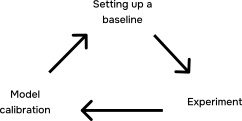
In line with the framework above, the insights gathered after closing the loop will lay the groundwork for identifying the next priorities and kicking off a new round of testing and model calibration.
The Complexity of E-commerce Analytics
Running an e-commerce business in the post-cookie era does not require tracking every single click perfectly. It takes the courage to test, an acceptance that the truth lies within statistical intervals, and swapping panic for systematic experimentation.
There are plenty of areas to test: from turning on a specific channel or adding activity in a new medium, through budget splits, the role of select creatives and ad formats, all the way to structural simplification, picking adequate campaign goals, and attribution windows. There are many ways to accurately weigh the effectiveness of a specific action, and they usually go far beyond the well-known Last-Click. Quite a lot to take in, right?
There are plenty of areas to test: from turning on a specific channel or adding activity in a new medium, through budget splits, the role of select creatives and ad formats, all the way to structural simplification, picking adequate campaign goals, and attribution windows. There are many ways to accurately weigh the effectiveness of a specific action, and they usually go far beyond the well-known Last-Click. Quite a lot to take in, right?
How to Break Out of Analytical Paranoia
At Klodt, we help sort out this chaos. We turn contradictory platform reports into a single, integrated signal arbitrage system tailored to the scale of your business. We provide strategic guidance on picking the right methodology, design incrementality tests, assist in setting up measurement models, and teach teams how to make budget decisions based on hard math rather than dashboard illusions.
By Krzysztof — Klodt.




June 2026 · ~ 9 min read
Dr. Paid or: How I learned to stop worrying about the Last-click and love the measurement
Most e-commerce directors and managers currently live in a state of permanent analytical paranoia. On one hand, we see shrinking margins eating into our P&L; on the other, ad network reports look like they were written by die-hard optimists. Google and Meta enthusiastically grade their own homework, handing themselves straight A's. Why, then, is it getting harder to trust dashboards when it comes to the entire business pie, rather than just a narrow slice of it?
There is no silver bullet here. There is no single, perfect system that will show you the absolute truth about which channel delivers best. Efficiency doesn't come from believing in dashboards; it comes from testing. True business maturity begins when, instead of chasing after a mythical single "source of truth", you accept the complexity of data and perspectives and learn to manage them.
The anatomy of an algorithmic hallucination
To embrace modern measurement, we first need to understand why current dashboards resemble a theater of illusions. After Apple cut off signals (iOS 14.5 and ATT), ad ecosystems permanently lost 40-60% of direct conversion data. The global opt-in rate for ATT hovers around a dismal 15-25%.
In response to this crisis, the platforms didn't back down – they rolled out probabilistic modeling. The result? Artificial ROAS inflation of 20-40% in ad panels. We’ve reached a point where the total revenue claimed by algorithms can be up to 2x higher than the actual revenue recorded in your store backend. On top of that, implementation errors can easily creep in, further widening these discrepancies.
Clinging to platform reports and Google Analytics as your sole gauge of performance is a direct path to capital self-destruction.
The Last-Click Syndrome: How We Pay for Free Customers
Our attachment to the Last-Click model is psychological: it provides an illusion of control. In practice, however, this model acts like a guided radar that frequently targets channels already capturing existing demand – primarily brand search and tight retargeting.
Hard market data shows, however, that 60% to 80% of conversions attributed to brand search campaigns would have happened naturally through organic traffic anyway.
For an e-commerce manager, the takeaway is simple: you are paying a commission for customers who were already standing at your store's doorstep with their credit cards out. Does this mean you should switch off these campaigns entirely? There is no one-size-fits-all answer. Cutting off brand keywords in a highly competitive niche might end up handing traffic over to rivals, while in other cases, it will purely free up margin. Striking this balance requires regular analysis and incrementality testing, which we will get into shortly.
Fair enough, but does that mean we should write off Last-Click entirely? Not quite. Traditional analytics models still hold ground today. What’s more, in justified cases, they can continue to be an effective tool backing up measurement during specific periods – for instance, when the sales cycle in a competitive industry wraps up in less than 7 days, or when you generate over 1000 conversions a month from highly stable customers. If your business doesn't fit into this framework, Last-Click might turn out to be a false prophet.
Strategic Mapping of the Front: MMM Across Scenarios
We already know that tracking every single user is now a fiction. This is where Marketing Mix Modeling (MMM) steps in – a strategic, macro-level approach where we analyze historical sales and spend data outside of ad platforms. For modern open-source frameworks (like Meta’s Robyn or Google’s Meridian), the death of cookies isn't a limitation because they look at the correlation between cost and revenue at a macro level. By using econometric modeling, they provide guidance on the most efficient budget allocation. Put simply, MMM will tell you when pumping more thousands into Facebook or Google Ads stops paying off, and where a given source still has room to scale up.
Implementing MMM is not a set-and-forget process. Depending on the scale of your e-commerce, the optimal measurement strategy will look completely different:
- For large businesses with marketing budgets exceeding approx. $3 million, where the media mix includes significant offline activity (>30%) or a long, complex buying cycle (>30 days), a full-scale MMM model becomes the only way to flag channel cannibalization and protect your margins. However, you must get past the data barrier: without a clean, historical foundation spanning at least 52, and ideally over 104 weeks, the model cannot separate your ad impact from natural seasonality (e.g., around Black Friday).
- If your e-commerce is in a dynamic growth phase and you spend between $200,000–$300,000 and $1.5 million annually, building a model from scratch is a waste of time – rolling out multi-month econometric projects can paralyze or, at best, slow down your business. In this situation, it is far better to pivot to lighter, turnkey SaaS solutions (such as Recast, Fospha, or technologies offered by Xlab) that automate the analytical process without draining company resources. On a daily basis, your primary compass remains Blended ROAS (the ratio of real sales revenue to total spend across all channels), as it allows you to keep your finger on the pulse here and now. Meanwhile, the lightweight SaaS MMM serves as a strategic validator – run every few weeks, it checks whether current decisions are running the business aground.
Incrementality: Fact-Checking Campaign "Sure Things"
How do you verify that the econometric model isn't wrong and that ad platforms aren't taking credit for someone else's work? This is where incrementality testing comes in. It answers the fundamental question: how much would I have made if I completely shut down this traffic source?
An e-commerce manager has several solid methodological alternatives at their disposal:
- GeoLift is currently the most powerful method for measuring campaign impact at the market or regional level. It compares regions with active advertising against control regions, reaching 80-95% accuracy in pinpointing the real impact of marketing efforts. It is an ideal solution for omnichannel businesses, as it allows you to measure how online ads stimulate brick-and-mortar sales.
- Conversion Lift is a solution known primarily from Meta’s ad tools, and from 2025 available in the Google ecosystem as well. In this study, we compare the purchasing behavior of a group that sees your ads with a control group from which the ads have been hidden. As a result, the experiment precisely identifies the clean, incremental impact of the campaign on sales, answering what sales would look like in a world where the ad ranversus how many people would buy anyway, without any campaign exposure. The test allows for a relatively cheap (entry threshold starting at a $5,000 budget per study in Google, or a specified spend and event quality level for social channels) and fast verification.
- Incrementality tests derived from Conversion Lift also include tools such as:
- Search Lift – measuring how specific actions (e.g., a YouTube video campaign) actually spark demand and purchase intent in search engines.
- Channel Lift examining the impact of Meta ads on GA4 transactions attributed to other sources.
- Universal Holdout (a permanent CRM control group) is an intriguing method for protecting margins against the automated handout of discounts, e.g. in Marketing Automation systems. It involves permanently shutting out 5-10% of your customer base from all newsletters, SMS messages, and automations to directly compare their LTV against the rest of the database. This is ideal for mature businesses or e-commerce operations with a high share of returning users, as it clearly singles out which messages generate pure, incremental profit and which merely subsidize purchases for customers who would have bought at full price anyway.
- Brand Lift – while this experiment does not measure sales directly, it lets you check whether expensive awareness campaigns, including video (e.g. YouTube, TikTok), are actually building future demand or just burning budget on empty impressions. It measures the declarative lift in purchase intent and brand awareness among people who saw the ad, vetting the top of the funnel long before users make a purchase. It is ideal for businesses in an aggressive scaling phase that want hard evidence that brand spend will translate into an increase in cheaper organic traffic and brand awareness down the line.
None of these tests will give you a permanent answer, though. Incrementality shifts over time – it depends on the season, competitor moves, and market saturation. The key is calibration: establishing a repeatable testing process.
The Triangulation Framework: How to Squeeze More from Your Budget Media Mix
Instead of getting frustrated that GA4 data doesn't line up with the results of your latest Demand Gen, TikTok Ads, various Partnership Ads on Meta, or affiliate marketing efforts, you need to step up to signal arbitrage. The future of modern e-commerce is not a permanent battle over a single, perfect attribution line, but an understanding of the relationships and dependencies between different data sources.
Deploying an integrated measurement framework yields tangible returns. Combining MMM (top-down strategy), Lift tests (the experimental anchor of truth), and MTA (ongoing, daily creative and bid optimization) can scale up the efficiency of marketing capital allocation by 20-30%.
Prerequisite: Data hygiene is the foundation of successful measurement and effective algorithm performance. Setting upserver-side tracking (Server-Side GTM and Meta CAPI) is now an absolute operational necessity that guards the baseline data stream against browser restrictions, while also making it easier to pass along custom analytical data, such as product margins.
Once your tech infrastructure is churning out high-quality data, the strategic implementation roadmap shapes up as follows:
Krok 1: Audit and Base Line
Goal: Identifying Discrepancies
Monitoring variances between ad dashboards and the store backend. At this stage, you map out real correction factors for platform reports and zero in on priority growth areas.
Step 2: Experimental Anchor of Truth
Goal: Verifying Incrementality
Launching the first incrementality test to validate hypotheses in a core area (e.g. GeoLift or platform hold-outs). This could be a Conversion Lift for your largest channel to first clash reported ROAS against real, incremental profit.
Step 3: Model Calibration
Goal: Dynamic Budget Allocation
Regularly feeding econometric models with hard data from lift tests (as Bayesian priors). This builds a safe, error-resistant operational model for strategically pinning down budgets across channels.
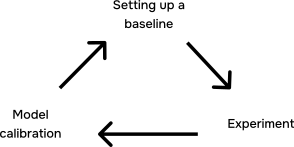
In line with the framework above, the insights gathered after closing the loop will lay the groundwork for identifying the next priorities and kicking off a new round of testing and model calibration.
The Complexity of E-commerce Analytics
Running an e-commerce business in the post-cookie era does not require tracking every single click perfectly. It takes the courage to test, an acceptance that the truth lies within statistical intervals, and swapping panic for systematic experimentation.
There are plenty of areas to test: from turning on a specific channel or adding activity in a new medium, through budget splits, the role of select creatives and ad formats, all the way to structural simplification, picking adequate campaign goals, and attribution windows. There are many ways to accurately weigh the effectiveness of a specific action, and they usually go far beyond the well-known Last-Click. Quite a lot to take in, right?
There are plenty of areas to test: from turning on a specific channel or adding activity in a new medium, through budget splits, the role of select creatives and ad formats, all the way to structural simplification, picking adequate campaign goals, and attribution windows. There are many ways to accurately weigh the effectiveness of a specific action, and they usually go far beyond the well-known Last-Click. Quite a lot to take in, right?
How to Break Out of Analytical Paranoia
At Klodt, we help sort out this chaos. We turn contradictory platform reports into a single, integrated signal arbitrage system tailored to the scale of your business. We provide strategic guidance on picking the right methodology, design incrementality tests, assist in setting up measurement models, and teach teams how to make budget decisions based on hard math rather than dashboard illusions.
By Krzysztof — Klodt.
June 2026 · ~ 9 min read
Dr. Paid or: How I learned to stop worrying about the Last-click and love the measurement
Most e-commerce directors and managers currently live in a state of permanent analytical paranoia. On one hand, we see shrinking margins eating into our P&L; on the other, ad network reports look like they were written by die-hard optimists. Google and Meta enthusiastically grade their own homework, handing themselves straight A's. Why, then, is it getting harder to trust dashboards when it comes to the entire business pie, rather than just a narrow slice of it?
There is no silver bullet here. There is no single, perfect system that will show you the absolute truth about which channel delivers best. Efficiency doesn't come from believing in dashboards; it comes from testing. True business maturity begins when, instead of chasing after a mythical single "source of truth", you accept the complexity of data and perspectives and learn to manage them.
The anatomy of an algorithmic hallucination
To embrace modern measurement, we first need to understand why current dashboards resemble a theater of illusions. After Apple cut off signals (iOS 14.5 and ATT), ad ecosystems permanently lost 40-60% of direct conversion data. The global opt-in rate for ATT hovers around a dismal 15-25%.
In response to this crisis, the platforms didn't back down – they rolled out probabilistic modeling. The result? Artificial ROAS inflation of 20-40% in ad panels. We’ve reached a point where the total revenue claimed by algorithms can be up to 2x higher than the actual revenue recorded in your store backend. On top of that, implementation errors can easily creep in, further widening these discrepancies.
Clinging to platform reports and Google Analytics as your sole gauge of performance is a direct path to capital self-destruction.
The Last-Click Syndrome: How We Pay for Free Customers
Our attachment to the Last-Click model is psychological: it provides an illusion of control. In practice, however, this model acts like a guided radar that frequently targets channels already capturing existing demand – primarily brand search and tight retargeting.
Hard market data shows, however, that 60% to 80% of conversions attributed to brand search campaigns would have happened naturally through organic traffic anyway.
For an e-commerce manager, the takeaway is simple: you are paying a commission for customers who were already standing at your store's doorstep with their credit cards out. Does this mean you should switch off these campaigns entirely? There is no one-size-fits-all answer. Cutting off brand keywords in a highly competitive niche might end up handing traffic over to rivals, while in other cases, it will purely free up margin. Striking this balance requires regular analysis and incrementality testing, which we will get into shortly.
Fair enough, but does that mean we should write off Last-Click entirely? Not quite. Traditional analytics models still hold ground today. What’s more, in justified cases, they can continue to be an effective tool backing up measurement during specific periods – for instance, when the sales cycle in a competitive industry wraps up in less than 7 days, or when you generate over 1000 conversions a month from highly stable customers. If your business doesn't fit into this framework, Last-Click might turn out to be a false prophet.
Strategic Mapping of the Front: MMM Across Scenarios
We already know that tracking every single user is now a fiction. This is where Marketing Mix Modeling (MMM) steps in – a strategic, macro-level approach where we analyze historical sales and spend data outside of ad platforms. For modern open-source frameworks (like Meta’s Robyn or Google’s Meridian), the death of cookies isn't a limitation because they look at the correlation between cost and revenue at a macro level. By using econometric modeling, they provide guidance on the most efficient budget allocation. Put simply, MMM will tell you when pumping more thousands into Facebook or Google Ads stops paying off, and where a given source still has room to scale up.
Implementing MMM is not a set-and-forget process. Depending on the scale of your e-commerce, the optimal measurement strategy will look completely different:
- For large businesses with marketing budgets exceeding approx. $3 million, where the media mix includes significant offline activity (>30%) or a long, complex buying cycle (>30 days), a full-scale MMM model becomes the only way to flag channel cannibalization and protect your margins. However, you must get past the data barrier: without a clean, historical foundation spanning at least 52, and ideally over 104 weeks, the model cannot separate your ad impact from natural seasonality (e.g., around Black Friday).
- If your e-commerce is in a dynamic growth phase and you spend between $200,000–$300,000 and $1.5 million annually, building a model from scratch is a waste of time – rolling out multi-month econometric projects can paralyze or, at best, slow down your business. In this situation, it is far better to pivot to lighter, turnkey SaaS solutions (such as Recast, Fospha, or technologies offered by Xlab) that automate the analytical process without draining company resources. On a daily basis, your primary compass remains Blended ROAS (the ratio of real sales revenue to total spend across all channels), as it allows you to keep your finger on the pulse here and now. Meanwhile, the lightweight SaaS MMM serves as a strategic validator – run every few weeks, it checks whether current decisions are running the business aground.
Incrementality: Fact-Checking Campaign "Sure Things"
How do you verify that the econometric model isn't wrong and that ad platforms aren't taking credit for someone else's work? This is where incrementality testing comes in. It answers the fundamental question: how much would I have made if I completely shut down this traffic source?
An e-commerce manager has several solid methodological alternatives at their disposal:
- GeoLift is currently the most powerful method for measuring campaign impact at the market or regional level. It compares regions with active advertising against control regions, reaching 80-95% accuracy in pinpointing the real impact of marketing efforts. It is an ideal solution for omnichannel businesses, as it allows you to measure how online ads stimulate brick-and-mortar sales.
- Conversion Lift is a solution known primarily from Meta’s ad tools, and from 2025 available in the Google ecosystem as well. In this study, we compare the purchasing behavior of a group that sees your ads with a control group from which the ads have been hidden. As a result, the experiment precisely identifies the clean, incremental impact of the campaign on sales, answering what sales would look like in a world where the ad ranversus how many people would buy anyway, without any campaign exposure. The test allows for a relatively cheap (entry threshold starting at a $5,000 budget per study in Google, or a specified spend and event quality level for social channels) and fast verification.
- Incrementality tests derived from Conversion Lift also include tools such as:
- Search Lift – measuring how specific actions (e.g., a YouTube video campaign) actually spark demand and purchase intent in search engines.
- Channel Lift examining the impact of Meta ads on GA4 transactions attributed to other sources.
- Universal Holdout (a permanent CRM control group) is an intriguing method for protecting margins against the automated handout of discounts, e.g. in Marketing Automation systems. It involves permanently shutting out 5-10% of your customer base from all newsletters, SMS messages, and automations to directly compare their LTV against the rest of the database. This is ideal for mature businesses or e-commerce operations with a high share of returning users, as it clearly singles out which messages generate pure, incremental profit and which merely subsidize purchases for customers who would have bought at full price anyway.
- Brand Lift – while this experiment does not measure sales directly, it lets you check whether expensive awareness campaigns, including video (e.g. YouTube, TikTok), are actually building future demand or just burning budget on empty impressions. It measures the declarative lift in purchase intent and brand awareness among people who saw the ad, vetting the top of the funnel long before users make a purchase. It is ideal for businesses in an aggressive scaling phase that want hard evidence that brand spend will translate into an increase in cheaper organic traffic and brand awareness down the line.
None of these tests will give you a permanent answer, though. Incrementality shifts over time – it depends on the season, competitor moves, and market saturation. The key is calibration: establishing a repeatable testing process.
The Triangulation Framework: How to Squeeze More from Your Budget Media Mix
Instead of getting frustrated that GA4 data doesn't line up with the results of your latest Demand Gen, TikTok Ads, various Partnership Ads on Meta, or affiliate marketing efforts, you need to step up to signal arbitrage. The future of modern e-commerce is not a permanent battle over a single, perfect attribution line, but an understanding of the relationships and dependencies between different data sources.
Deploying an integrated measurement framework yields tangible returns. Combining MMM (top-down strategy), Lift tests (the experimental anchor of truth), and MTA (ongoing, daily creative and bid optimization) can scale up the efficiency of marketing capital allocation by 20-30%.
Prerequisite: Data hygiene is the foundation of successful measurement and effective algorithm performance. Setting upserver-side tracking (Server-Side GTM and Meta CAPI) is now an absolute operational necessity that guards the baseline data stream against browser restrictions, while also making it easier to pass along custom analytical data, such as product margins.
Once your tech infrastructure is churning out high-quality data, the strategic implementation roadmap shapes up as follows:
Krok 1: Audit and Base Line
Goal: Identifying Discrepancies
Monitoring variances between ad dashboards and the store backend. At this stage, you map out real correction factors for platform reports and zero in on priority growth areas.
Step 2: Experimental Anchor of Truth
Goal: Verifying Incrementality
Launching the first incrementality test to validate hypotheses in a core area (e.g. GeoLift or platform hold-outs). This could be a Conversion Lift for your largest channel to first clash reported ROAS against real, incremental profit.
Step 3: Model Calibration
Goal: Dynamic Budget Allocation
Regularly feeding econometric models with hard data from lift tests (as Bayesian priors). This builds a safe, error-resistant operational model for strategically pinning down budgets across channels.

In line with the framework above, the insights gathered after closing the loop will lay the groundwork for identifying the next priorities and kicking off a new round of testing and model calibration.
The Complexity of E-commerce Analytics
Running an e-commerce business in the post-cookie era does not require tracking every single click perfectly. It takes the courage to test, an acceptance that the truth lies within statistical intervals, and swapping panic for systematic experimentation.
There are plenty of areas to test: from turning on a specific channel or adding activity in a new medium, through budget splits, the role of select creatives and ad formats, all the way to structural simplification, picking adequate campaign goals, and attribution windows. There are many ways to accurately weigh the effectiveness of a specific action, and they usually go far beyond the well-known Last-Click. Quite a lot to take in, right?
There are plenty of areas to test: from turning on a specific channel or adding activity in a new medium, through budget splits, the role of select creatives and ad formats, all the way to structural simplification, picking adequate campaign goals, and attribution windows. There are many ways to accurately weigh the effectiveness of a specific action, and they usually go far beyond the well-known Last-Click. Quite a lot to take in, right?
How to Break Out of Analytical Paranoia
At Klodt, we help sort out this chaos. We turn contradictory platform reports into a single, integrated signal arbitrage system tailored to the scale of your business. We provide strategic guidance on picking the right methodology, design incrementality tests, assist in setting up measurement models, and teach teams how to make budget decisions based on hard math rather than dashboard illusions.
By Krzysztof — Klodt.

Privacy policy
© 2026 Klodt. Studio
Insight
articles

June 2026 · ~ 9 min read
Dr. Paid or: How I learned to stop worrying about the Last-click and love the measurement
Most e-commerce directors and managers currently live in a state of permanent analytical paranoia. On one hand, we see shrinking margins eating into our P&L; on the other, ad network reports look like they were written by die-hard optimists. Google and Meta enthusiastically grade their own homework, handing themselves straight A's. Why, then, is it getting harder to trust dashboards when it comes to the entire business pie, rather than just a narrow slice of it?
There is no silver bullet here. There is no single, perfect system that will show you the absolute truth about which channel delivers best. Efficiency doesn't come from believing in dashboards; it comes from testing. True business maturity begins when, instead of chasing after a mythical single "source of truth", you accept the complexity of data and perspectives and learn to manage them.
The anatomy of an algorithmic hallucination
To embrace modern measurement, we first need to understand why current dashboards resemble a theater of illusions. After Apple cut off signals (iOS 14.5 and ATT), ad ecosystems permanently lost 40-60% of direct conversion data. The global opt-in rate for ATT hovers around a dismal 15-25%.
In response to this crisis, the platforms didn't back down – they rolled out probabilistic modeling. The result? Artificial ROAS inflation of 20-40% in ad panels. We’ve reached a point where the total revenue claimed by algorithms can be up to 2x higher than the actual revenue recorded in your store backend. On top of that, implementation errors can easily creep in, further widening these discrepancies.
Clinging to platform reports and Google Analytics as your sole gauge of performance is a direct path to capital self-destruction.
The Last-Click Syndrome: How We Pay for Free Customers
Our attachment to the Last-Click model is psychological: it provides an illusion of control. In practice, however, this model acts like a guided radar that frequently targets channels already capturing existing demand – primarily brand search and tight retargeting.
Hard market data shows, however, that 60% to 80% of conversions attributed to brand search campaigns would have happened naturally through organic traffic anyway.
For an e-commerce manager, the takeaway is simple: you are paying a commission for customers who were already standing at your store's doorstep with their credit cards out. Does this mean you should switch off these campaigns entirely? There is no one-size-fits-all answer. Cutting off brand keywords in a highly competitive niche might end up handing traffic over to rivals, while in other cases, it will purely free up margin. Striking this balance requires regular analysis and incrementality testing, which we will get into shortly.
Fair enough, but does that mean we should write off Last-Click entirely? Not quite. Traditional analytics models still hold ground today. What’s more, in justified cases, they can continue to be an effective tool backing up measurement during specific periods – for instance, when the sales cycle in a competitive industry wraps up in less than 7 days, or when you generate over 1000 conversions a month from highly stable customers. If your business doesn't fit into this framework, Last-Click might turn out to be a false prophet.
Strategic Mapping of the Front: MMM Across Scenarios
We already know that tracking every single user is now a fiction. This is where Marketing Mix Modeling (MMM) steps in – a strategic, macro-level approach where we analyze historical sales and spend data outside of ad platforms. For modern open-source frameworks (like Meta’s Robyn or Google’s Meridian), the death of cookies isn't a limitation because they look at the correlation between cost and revenue at a macro level. By using econometric modeling, they provide guidance on the most efficient budget allocation. Put simply, MMM will tell you when pumping more thousands into Facebook or Google Ads stops paying off, and where a given source still has room to scale up.
Implementing MMM is not a set-and-forget process. Depending on the scale of your e-commerce, the optimal measurement strategy will look completely different:
- For large businesses with marketing budgets exceeding approx. $3 million, where the media mix includes significant offline activity (>30%) or a long, complex buying cycle (>30 days), a full-scale MMM model becomes the only way to flag channel cannibalization and protect your margins. However, you must get past the data barrier: without a clean, historical foundation spanning at least 52, and ideally over 104 weeks, the model cannot separate your ad impact from natural seasonality (e.g., around Black Friday).
- If your e-commerce is in a dynamic growth phase and you spend between $200,000–$300,000 and $1.5 million annually, building a model from scratch is a waste of time – rolling out multi-month econometric projects can paralyze or, at best, slow down your business. In this situation, it is far better to pivot to lighter, turnkey SaaS solutions (such as Recast, Fospha, or technologies offered by Xlab) that automate the analytical process without draining company resources. On a daily basis, your primary compass remains Blended ROAS (the ratio of real sales revenue to total spend across all channels), as it allows you to keep your finger on the pulse here and now. Meanwhile, the lightweight SaaS MMM serves as a strategic validator – run every few weeks, it checks whether current decisions are running the business aground.
Incrementality: Fact-Checking Campaign "Sure Things"
How do you verify that the econometric model isn't wrong and that ad platforms aren't taking credit for someone else's work? This is where incrementality testing comes in. It answers the fundamental question: how much would I have made if I completely shut down this traffic source?
An e-commerce manager has several solid methodological alternatives at their disposal:
- GeoLift is currently the most powerful method for measuring campaign impact at the market or regional level. It compares regions with active advertising against control regions, reaching 80-95% accuracy in pinpointing the real impact of marketing efforts. It is an ideal solution for omnichannel businesses, as it allows you to measure how online ads stimulate brick-and-mortar sales.
- Conversion Lift is a solution known primarily from Meta’s ad tools, and from 2025 available in the Google ecosystem as well. In this study, we compare the purchasing behavior of a group that sees your ads with a control group from which the ads have been hidden. As a result, the experiment precisely identifies the clean, incremental impact of the campaign on sales, answering what sales would look like in a world where the ad ranversus how many people would buy anyway, without any campaign exposure. The test allows for a relatively cheap (entry threshold starting at a $5,000 budget per study in Google, or a specified spend and event quality level for social channels) and fast verification.
- Incrementality tests derived from Conversion Lift also include tools such as:
- Search Lift – measuring how specific actions (e.g., a YouTube video campaign) actually spark demand and purchase intent in search engines.
- Channel Lift examining the impact of Meta ads on GA4 transactions attributed to other sources.
- Universal Holdout (a permanent CRM control group) is an intriguing method for protecting margins against the automated handout of discounts, e.g. in Marketing Automation systems. It involves permanently shutting out 5-10% of your customer base from all newsletters, SMS messages, and automations to directly compare their LTV against the rest of the database. This is ideal for mature businesses or e-commerce operations with a high share of returning users, as it clearly singles out which messages generate pure, incremental profit and which merely subsidize purchases for customers who would have bought at full price anyway.
- Brand Lift – while this experiment does not measure sales directly, it lets you check whether expensive awareness campaigns, including video (e.g. YouTube, TikTok), are actually building future demand or just burning budget on empty impressions. It measures the declarative lift in purchase intent and brand awareness among people who saw the ad, vetting the top of the funnel long before users make a purchase. It is ideal for businesses in an aggressive scaling phase that want hard evidence that brand spend will translate into an increase in cheaper organic traffic and brand awareness down the line.
None of these tests will give you a permanent answer, though. Incrementality shifts over time – it depends on the season, competitor moves, and market saturation. The key is calibration: establishing a repeatable testing process.
The Triangulation Framework: How to Squeeze More from Your Budget Media Mix
Instead of getting frustrated that GA4 data doesn't line up with the results of your latest Demand Gen, TikTok Ads, various Partnership Ads on Meta, or affiliate marketing efforts, you need to step up to signal arbitrage. The future of modern e-commerce is not a permanent battle over a single, perfect attribution line, but an understanding of the relationships and dependencies between different data sources.
Deploying an integrated measurement framework yields tangible returns. Combining MMM (top-down strategy), Lift tests (the experimental anchor of truth), and MTA (ongoing, daily creative and bid optimization) can scale up the efficiency of marketing capital allocation by 20-30%.
Prerequisite: Data hygiene is the foundation of successful measurement and effective algorithm performance. Setting upserver-side tracking (Server-Side GTM and Meta CAPI) is now an absolute operational necessity that guards the baseline data stream against browser restrictions, while also making it easier to pass along custom analytical data, such as product margins.
Once your tech infrastructure is churning out high-quality data, the strategic implementation roadmap shapes up as follows:
Krok 1: Audit and Base Line
Goal: Identifying Discrepancies
Monitoring variances between ad dashboards and the store backend. At this stage, you map out real correction factors for platform reports and zero in on priority growth areas.
Step 2: Experimental Anchor of Truth
Goal: Verifying Incrementality
Launching the first incrementality test to validate hypotheses in a core area (e.g. GeoLift or platform hold-outs). This could be a Conversion Lift for your largest channel to first clash reported ROAS against real, incremental profit.
Step 3: Model Calibration
Goal: Dynamic Budget Allocation
Regularly feeding econometric models with hard data from lift tests (as Bayesian priors). This builds a safe, error-resistant operational model for strategically pinning down budgets across channels.

In line with the framework above, the insights gathered after closing the loop will lay the groundwork for identifying the next priorities and kicking off a new round of testing and model calibration.
The Complexity of E-commerce Analytics
Running an e-commerce business in the post-cookie era does not require tracking every single click perfectly. It takes the courage to test, an acceptance that the truth lies within statistical intervals, and swapping panic for systematic experimentation.
There are plenty of areas to test: from turning on a specific channel or adding activity in a new medium, through budget splits, the role of select creatives and ad formats, all the way to structural simplification, picking adequate campaign goals, and attribution windows. There are many ways to accurately weigh the effectiveness of a specific action, and they usually go far beyond the well-known Last-Click. Quite a lot to take in, right?
There are plenty of areas to test: from turning on a specific channel or adding activity in a new medium, through budget splits, the role of select creatives and ad formats, all the way to structural simplification, picking adequate campaign goals, and attribution windows. There are many ways to accurately weigh the effectiveness of a specific action, and they usually go far beyond the well-known Last-Click. Quite a lot to take in, right?
How to Break Out of Analytical Paranoia
At Klodt, we help sort out this chaos. We turn contradictory platform reports into a single, integrated signal arbitrage system tailored to the scale of your business. We provide strategic guidance on picking the right methodology, design incrementality tests, assist in setting up measurement models, and teach teams how to make budget decisions based on hard math rather than dashboard illusions.
By Krzysztof — Klodt.

Insight
articles
June 2026 · ~ 9 min read
Dr. Paid or: How I learned to stop worrying about the Last-click and love the measurement
Most e-commerce directors and managers currently live in a state of permanent analytical paranoia. On one hand, we see shrinking margins eating into our P&L; on the other, ad network reports look like they were written by die-hard optimists. Google and Meta enthusiastically grade their own homework, handing themselves straight A's. Why, then, is it getting harder to trust dashboards when it comes to the entire business pie, rather than just a narrow slice of it?
There is no silver bullet here. There is no single, perfect system that will show you the absolute truth about which channel delivers best. Efficiency doesn't come from believing in dashboards; it comes from testing. True business maturity begins when, instead of chasing after a mythical single "source of truth", you accept the complexity of data and perspectives and learn to manage them.
The anatomy of an algorithmic hallucination
To embrace modern measurement, we first need to understand why current dashboards resemble a theater of illusions. After Apple cut off signals (iOS 14.5 and ATT), ad ecosystems permanently lost 40-60% of direct conversion data. The global opt-in rate for ATT hovers around a dismal 15-25%.
In response to this crisis, the platforms didn't back down – they rolled out probabilistic modeling. The result? Artificial ROAS inflation of 20-40% in ad panels. We’ve reached a point where the total revenue claimed by algorithms can be up to 2x higher than the actual revenue recorded in your store backend. On top of that, implementation errors can easily creep in, further widening these discrepancies.
Clinging to platform reports and Google Analytics as your sole gauge of performance is a direct path to capital self-destruction.
The Last-Click Syndrome: How We Pay for Free Customers
Our attachment to the Last-Click model is psychological: it provides an illusion of control. In practice, however, this model acts like a guided radar that frequently targets channels already capturing existing demand – primarily brand search and tight retargeting.
Hard market data shows, however, that 60% to 80% of conversions attributed to brand search campaigns would have happened naturally through organic traffic anyway.
For an e-commerce manager, the takeaway is simple: you are paying a commission for customers who were already standing at your store's doorstep with their credit cards out. Does this mean you should switch off these campaigns entirely? There is no one-size-fits-all answer. Cutting off brand keywords in a highly competitive niche might end up handing traffic over to rivals, while in other cases, it will purely free up margin. Striking this balance requires regular analysis and incrementality testing, which we will get into shortly.
Fair enough, but does that mean we should write off Last-Click entirely? Not quite. Traditional analytics models still hold ground today. What’s more, in justified cases, they can continue to be an effective tool backing up measurement during specific periods – for instance, when the sales cycle in a competitive industry wraps up in less than 7 days, or when you generate over 1000 conversions a month from highly stable customers. If your business doesn't fit into this framework, Last-Click might turn out to be a false prophet.
Strategic Mapping of the Front: MMM Across Scenarios
We already know that tracking every single user is now a fiction. This is where Marketing Mix Modeling (MMM) steps in – a strategic, macro-level approach where we analyze historical sales and spend data outside of ad platforms. For modern open-source frameworks (like Meta’s Robyn or Google’s Meridian), the death of cookies isn't a limitation because they look at the correlation between cost and revenue at a macro level. By using econometric modeling, they provide guidance on the most efficient budget allocation. Put simply, MMM will tell you when pumping more thousands into Facebook or Google Ads stops paying off, and where a given source still has room to scale up.
Implementing MMM is not a set-and-forget process. Depending on the scale of your e-commerce, the optimal measurement strategy will look completely different:
- For large businesses with marketing budgets exceeding approx. $3 million, where the media mix includes significant offline activity (>30%) or a long, complex buying cycle (>30 days), a full-scale MMM model becomes the only way to flag channel cannibalization and protect your margins. However, you must get past the data barrier: without a clean, historical foundation spanning at least 52, and ideally over 104 weeks, the model cannot separate your ad impact from natural seasonality (e.g., around Black Friday).
- If your e-commerce is in a dynamic growth phase and you spend between $200,000–$300,000 and $1.5 million annually, building a model from scratch is a waste of time – rolling out multi-month econometric projects can paralyze or, at best, slow down your business. In this situation, it is far better to pivot to lighter, turnkey SaaS solutions (such as Recast, Fospha, or technologies offered by Xlab) that automate the analytical process without draining company resources. On a daily basis, your primary compass remains Blended ROAS (the ratio of real sales revenue to total spend across all channels), as it allows you to keep your finger on the pulse here and now. Meanwhile, the lightweight SaaS MMM serves as a strategic validator – run every few weeks, it checks whether current decisions are running the business aground.
Incrementality: Fact-Checking Campaign "Sure Things"
How do you verify that the econometric model isn't wrong and that ad platforms aren't taking credit for someone else's work? This is where incrementality testing comes in. It answers the fundamental question: how much would I have made if I completely shut down this traffic source?
An e-commerce manager has several solid methodological alternatives at their disposal:
- GeoLift is currently the most powerful method for measuring campaign impact at the market or regional level. It compares regions with active advertising against control regions, reaching 80-95% accuracy in pinpointing the real impact of marketing efforts. It is an ideal solution for omnichannel businesses, as it allows you to measure how online ads stimulate brick-and-mortar sales.
- Conversion Lift is a solution known primarily from Meta’s ad tools, and from 2025 available in the Google ecosystem as well. In this study, we compare the purchasing behavior of a group that sees your ads with a control group from which the ads have been hidden. As a result, the experiment precisely identifies the clean, incremental impact of the campaign on sales, answering what sales would look like in a world where the ad ranversus how many people would buy anyway, without any campaign exposure. The test allows for a relatively cheap (entry threshold starting at a $5,000 budget per study in Google, or a specified spend and event quality level for social channels) and fast verification.
- Incrementality tests derived from Conversion Lift also include tools such as:
- Search Lift – measuring how specific actions (e.g., a YouTube video campaign) actually spark demand and purchase intent in search engines.
- Channel Lift examining the impact of Meta ads on GA4 transactions attributed to other sources.
- Universal Holdout (a permanent CRM control group) is an intriguing method for protecting margins against the automated handout of discounts, e.g. in Marketing Automation systems. It involves permanently shutting out 5-10% of your customer base from all newsletters, SMS messages, and automations to directly compare their LTV against the rest of the database. This is ideal for mature businesses or e-commerce operations with a high share of returning users, as it clearly singles out which messages generate pure, incremental profit and which merely subsidize purchases for customers who would have bought at full price anyway.
- Brand Lift – while this experiment does not measure sales directly, it lets you check whether expensive awareness campaigns, including video (e.g. YouTube, TikTok), are actually building future demand or just burning budget on empty impressions. It measures the declarative lift in purchase intent and brand awareness among people who saw the ad, vetting the top of the funnel long before users make a purchase. It is ideal for businesses in an aggressive scaling phase that want hard evidence that brand spend will translate into an increase in cheaper organic traffic and brand awareness down the line.
None of these tests will give you a permanent answer, though. Incrementality shifts over time – it depends on the season, competitor moves, and market saturation. The key is calibration: establishing a repeatable testing process.
The Triangulation Framework: How to Squeeze More from Your Budget Media Mix
Instead of getting frustrated that GA4 data doesn't line up with the results of your latest Demand Gen, TikTok Ads, various Partnership Ads on Meta, or affiliate marketing efforts, you need to step up to signal arbitrage. The future of modern e-commerce is not a permanent battle over a single, perfect attribution line, but an understanding of the relationships and dependencies between different data sources.
Deploying an integrated measurement framework yields tangible returns. Combining MMM (top-down strategy), Lift tests (the experimental anchor of truth), and MTA (ongoing, daily creative and bid optimization) can scale up the efficiency of marketing capital allocation by 20-30%.
Prerequisite: Data hygiene is the foundation of successful measurement and effective algorithm performance. Setting upserver-side tracking (Server-Side GTM and Meta CAPI) is now an absolute operational necessity that guards the baseline data stream against browser restrictions, while also making it easier to pass along custom analytical data, such as product margins.
Once your tech infrastructure is churning out high-quality data, the strategic implementation roadmap shapes up as follows:
Krok 1: Audit and Base Line
Goal: Identifying Discrepancies
Monitoring variances between ad dashboards and the store backend. At this stage, you map out real correction factors for platform reports and zero in on priority growth areas.
Step 2: Experimental Anchor of Truth
Goal: Verifying Incrementality
Launching the first incrementality test to validate hypotheses in a core area (e.g. GeoLift or platform hold-outs). This could be a Conversion Lift for your largest channel to first clash reported ROAS against real, incremental profit.
Step 3: Model Calibration
Goal: Dynamic Budget Allocation
Regularly feeding econometric models with hard data from lift tests (as Bayesian priors). This builds a safe, error-resistant operational model for strategically pinning down budgets across channels.
In line with the framework above, the insights gathered after closing the loop will lay the groundwork for identifying the next priorities and kicking off a new round of testing and model calibration.
The Complexity of E-commerce Analytics
Running an e-commerce business in the post-cookie era does not require tracking every single click perfectly. It takes the courage to test, an acceptance that the truth lies within statistical intervals, and swapping panic for systematic experimentation.
There are plenty of areas to test: from turning on a specific channel or adding activity in a new medium, through budget splits, the role of select creatives and ad formats, all the way to structural simplification, picking adequate campaign goals, and attribution windows. There are many ways to accurately weigh the effectiveness of a specific action, and they usually go far beyond the well-known Last-Click. Quite a lot to take in, right?
There are plenty of areas to test: from turning on a specific channel or adding activity in a new medium, through budget splits, the role of select creatives and ad formats, all the way to structural simplification, picking adequate campaign goals, and attribution windows. There are many ways to accurately weigh the effectiveness of a specific action, and they usually go far beyond the well-known Last-Click. Quite a lot to take in, right?
How to Break Out of Analytical Paranoia
At Klodt, we help sort out this chaos. We turn contradictory platform reports into a single, integrated signal arbitrage system tailored to the scale of your business. We provide strategic guidance on picking the right methodology, design incrementality tests, assist in setting up measurement models, and teach teams how to make budget decisions based on hard math rather than dashboard illusions.
By Krzysztof — Klodt.
Insight
articles